A fire involving ordinary materials such as wood, paper, cloth, and certain plastics is classified as a Class A fire. These fires can occur in homes, offices, schools, warehouses, and industrial facilities. Although they are common, they can spread quickly when combustible materials are present.
Understanding Class A fires helps people recognize potential hazards, select suitable fire extinguishers, and respond more safely during emergencies. It is also important to understand how Class A fires differ from electrical, flammable-liquid, and cooking-oil fires.
This guide explains what a Class A fire is, common examples, suitable extinguishers, and practical fire-safety precautions.
What Is a Class A Fire?
A Class A fire is a fire involving ordinary combustible materials that can burn and leave behind ash or embers. Common fuels include wood, paper, cardboard, cloth, rubber, and certain plastics. These materials are found in everyday environments, which makes Class A fires a common concern in residential, commercial, and industrial buildings.
For example, a burning cardboard box, wooden desk, paper-filled wastebasket, or fabric-covered chair can produce a Class A fire.
According to the US Occupational Safety and Health Administration (OSHA), a Class A fire involves ordinary combustible materials such as paper, wood, cloth, and some rubber and plastic materials. This classification helps identify the type of fuel involved and determine suitable fire protection measures.
However, an ordinary combustible fire involving energized electrical equipment requires additional precautions. Never assume water is safe simply because the visible fuel is wood, paper, or fabric.
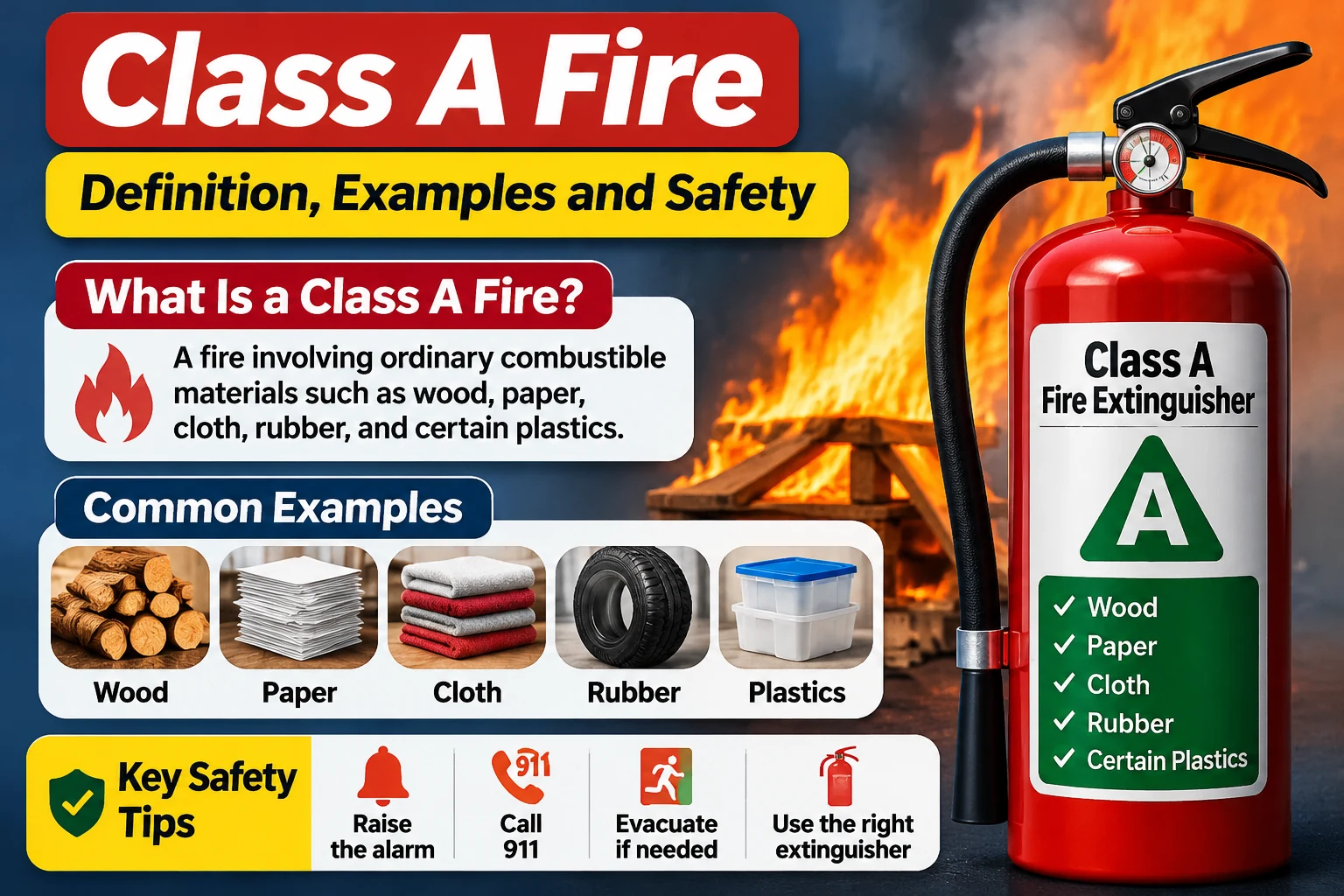
Examples of Class A Fires
Class A fires can develop in many everyday situations. Recognizing common examples makes it easier to understand where these hazards exist.
Here are some typical examples.
1. Wood Fires
Wood is a common combustible material found in furniture, doors, flooring, construction materials, and wooden storage structures.
A burning wooden table, cabinet, bookshelf, or pile of lumber can produce a Class A fire.
Wood fires can continue burning even after visible flames decrease because heat may remain inside the material. Smoldering wood can also produce smoke and reignite if hot embers remain.
2. Paper and Cardboard Fires
Paper and cardboard can catch fire easily when exposed to sparks, open flames, or excessive heat.
Common examples include:
- Burning newspapers and magazines
- Cardboard packaging catching fire
- Paper-filled wastebaskets
- Documents stored near heating equipment
- Paper products exposed to candles
Large quantities of paper and cardboard can provide enough fuel for a fire to spread rapidly.
3. Fabric and Clothing Fires
Clothing, curtains, carpets, upholstered furniture, and other textiles can contribute to Class A fires.
For example, a curtain may catch fire after coming into contact with a candle flame. Upholstered furniture can also become involved when exposed to an ignition source.
Different fabrics burn at different rates, so the speed of fire development depends on the material and surrounding conditions.
4. Rubber Fires
Rubber products, including certain tires, mats, hoses, and industrial components, can contribute to Class A fires.
These fires may produce dense smoke and hazardous combustion products.
Burning rubber can release toxic substances, so people should avoid approaching or attempting to handle such fires without professional training and appropriate protective equipment.
5. Certain Plastic Fires
Some plastic materials are included in the ordinary combustible category.
Examples include certain plastic packaging, containers, household products, and other combustible plastic items.
Not all plastics behave identically during a fire. Their composition can influence ignition, flame development, smoke production, and the hazards created.
What Materials Cause Class A Fires?
Class A fires involve ordinary combustible solid materials. The following table summarizes common examples and where they may be encountered.
| Material | Common examples |
|---|---|
| Wood | Furniture, doors, lumber |
| Paper | Newspapers, documents, books |
| Cardboard | Packaging, storage boxes |
| Fabric | Curtains, clothing, carpets |
| Rubber | Mats, certain tires and products |
| Plastics | Certain containers and packaging |
| Upholstery | Sofas, chairs, cushions |
The presence of these materials does not automatically mean a fire will occur. An ignition source, sufficient heat, and suitable burning conditions are also required.
Keeping combustible materials away from heat sources and maintaining good housekeeping can reduce unnecessary fire risks.
How Do Class A Fires Start and Spread?
A Class A fire requires three essential elements: heat, fuel, and oxygen. These components form the fire triangle.
- Heat: An ignition source provides enough energy to start combustion.
- Fuel: Combustible materials such as wood, paper, or fabric support burning.
- Oxygen: Oxygen in the surrounding air supports the combustion process.
A fire can continue developing when these elements remain available.
For example, a paper-filled wastebasket may ignite when exposed to a discarded burning material. Nearby cardboard, furniture, and curtains can then provide additional fuel.
Several factors influence how quickly a Class A fire spreads:
- Material type: Thin paper and dry wood can ignite differently from thick wooden furniture or dense textiles.
- Fuel quantity: Large amounts of combustible materials can support a more substantial fire.
- Air movement: Ventilation and airflow can influence flame development.
- Surrounding conditions: Room temperature, available oxygen, and the arrangement of combustible materials can affect fire behavior.
Understanding these factors helps explain why good housekeeping and appropriate fire protection are important.
What Is a Fire Extinguisher Class?
A fire extinguisher class identifies the type of fire an extinguisher is designed and tested to fight.
In the United States, portable fire extinguishers are labeled according to the fire hazards they can address. The five primary categories are A, B, C, D, and K.
Each category represents a different type of burning material or hazard.
| Class | Type of fire | Common examples |
|---|---|---|
| Class A | Ordinary combustibles | Wood, paper, cloth |
| Class B | Flammable liquids and gases | Gasoline, solvents, propane |
| Class C | Energized electrical equipment | Electrical panels, appliances |
| Class D | Combustible metals | Magnesium, sodium, titanium |
| Class K | Cooking oils and fats | Commercial deep fryers |
The letter on an extinguisher indicates its approved fire classification. Some extinguishers carry multiple letters, meaning they are suitable for more than one fire class.
For example, an ABC extinguisher is designed for Class A, Class B, and Class C hazards.
Choosing the correct extinguisher matters because an unsuitable extinguishing agent can make certain fires more dangerous.
What Is a Class A Fire Extinguisher Used For?
A Class A fire extinguisher is used for fires involving ordinary combustible materials such as wood, paper, cardboard, fabric, rubber, and certain plastics.
These extinguishers are commonly used in locations where ordinary combustible materials are present.
Examples include:
- Homes and residential buildings
- Offices and commercial properties
- Schools and educational facilities
- Warehouses and storage areas
- Manufacturing facilities
- Workshops and other workplaces
Different extinguishing agents can be approved for Class A fires.
Water Fire Extinguishers
Water extinguishers are commonly used for Class A fires because water absorbs heat and cools the burning material. This cooling action helps lower the material’s temperature below the level needed to sustain combustion. However, standard water extinguishers must not be used on energized electrical equipment or flammable-liquid fires.
ABC Dry Chemical Fire Extinguishers
ABC dry chemical extinguishers commonly use monoammonium phosphate.
They are designed to address Class A, B, and C fires and are frequently selected for general-purpose fire protection. The agent interrupts combustion and helps suppress the flames. ABC extinguishers are useful in environments where different fire hazards may exist. However, their powder can leave residue that may require cleanup, particularly around sensitive equipment.
Water Mist Fire Extinguishers
Water mist extinguishers produce very small water droplets. Some models are specifically tested and listed for multiple fire classes, depending on their design and certification.
Always check the extinguisher’s label rather than assuming every water mist extinguisher is suitable for electrical fires.
Foam Fire Extinguishers
Certain foam extinguishers are approved for both Class A and Class B fires. They can help cool ordinary combustible materials while creating a foam layer over suitable burning liquid surfaces.
Their suitability depends on the specific agent and its certification.
What Is a Class C Fire Extinguisher?
A Class C fire extinguisher is designed for fires involving energized electrical equipment. These fires present an additional electrical shock hazard. Therefore, the extinguishing agent must be electrically nonconductive for the relevant application.
Common examples of potential Class C fire hazards include:
- Electrical control panels
- Live wiring
- Computers and electronic equipment
- Power tools connected to electricity
- Electrical distribution equipment
- Energized appliances
Class C fire extinguishers commonly include suitable carbon dioxide (CO2), clean-agent, or multipurpose dry chemical models. The correct choice depends on the equipment, surroundings, and extinguisher listing.
What Are Class C Fire Extinguishers Used For?
Class C fire extinguishers are used to suppress fires involving energized electrical equipment without introducing a conductive extinguishing agent.
For example, a fire involving an energized electrical control panel requires an extinguisher approved for Class C hazards.
Once the electrical equipment has been safely de-energized, the remaining fire classification depends on the material that continues burning. This distinction is important because electrical power may be the original ignition source, but the actual fuel could be insulation, plastic, paper, or another combustible material. Never touch burning electrical equipment or attempt to disconnect power if doing so would expose you to danger.
Types of Fire Extinguishers for Class A Fires
Selecting an appropriate extinguisher requires checking its classification, agent, and intended application.
Here is a comparison of common options.
| Extinguisher type | Class A suitability | Important consideration |
|---|---|---|
| Water | Yes, when correctly rated | Not for energized electrical or flammable-liquid fires |
| ABC dry chemical | Yes | Also covers B and C hazards |
| Water mist | Depends on listing | Check approved fire classes |
| Foam | Depends on agent and listing | Some models cover A and B |
An extinguisher should always be listed and labeled for the specific hazards it is intended to protect against.
Understanding Class A Extinguisher Ratings
Fire extinguishers may include numerical ratings before their classification letters.
For example, a label reading 2A:10B identifies the extinguisher’s performance classifications. The number before the letter A indicates its relative extinguishing effectiveness based on standardized testing. Under the US rating system, each A unit represents an equivalent of 1.25 gallons of water in the rating calculation.
Therefore, a 2A rating represents the equivalent of 2.5 gallons of water in that rating system. It does not mean the extinguisher’s actual container holds that amount of water. The B rating uses a different numerical scale based on the size of the test fire.
Class C does not have a numerical rating. Its letter indicates that the extinguishing agent is suitable for energized electrical equipment because it is electrically nonconductive.
How to Safely Respond to a Class A Fire
Even ordinary combustible fires can become life-threatening. A small fire can grow rapidly when additional fuel is nearby.
Follow these basic precautions:
1. Raise the Alarm
Alert everyone in the affected area as soon as a fire is discovered.
Activate the building fire alarm if available and follow the established evacuation procedure.
2. Call Emergency Services
Contact 911 in the United States and provide the location and nature of the fire.
Do not delay emergency notification while attempting to control the flames.
3. Evacuate When Necessary
Leave the building if smoke spreads, flames increase, or the fire threatens your escape route.
Keep away from smoke because it can contain harmful gases and particles.
4. Use the Correct Extinguisher
Only consider using an extinguisher when the fire is small, contained, and in its early stage.
The extinguisher must be appropriate for the fire classification.
Only trained people who can operate the equipment safely should attempt to use it.
5. Maintain a Clear Escape Route
Never position yourself where the fire could block your exit.
If the extinguisher does not control the fire immediately, leave the area and close doors behind you when safe.
Property protection should never take priority over personal safety.
Class A Fire vs. Other Fire Classes
Understanding the differences between fire classifications helps prevent incorrect extinguisher selection.
Class A vs. Class B Fire
Class A fires involve ordinary combustible solids, while Class B fires involve flammable or combustible liquids and gases. A burning wooden chair is an example of Class A. Burning gasoline is an example of Class B.
The extinguishing agent must match the fuel involved.
Class A vs. Class C Fire
Class A fires involve ordinary combustible materials. Class C fires involve energized electrical equipment. A burning paper box is a Class A hazard. A fire involving a live electrical panel is a Class C hazard.
The main safety distinction is the electrical shock risk associated with energized equipment.
Class A vs. Class D Fire
Class D fires involve combustible metals such as magnesium, titanium, sodium, and lithium. They require specialized dry powder extinguishing agents suitable for the particular metal.
Ordinary water extinguishers must not be used on combustible-metal fires unless a specialized product is explicitly approved for that hazard.
Class A vs. Class K Fire
Class K fires involve combustible cooking media, including vegetable oils, animal oils, and fats in cooking appliances. They commonly occur in commercial kitchens and require suitable kitchen fire protection equipment.
Water should not be poured onto burning cooking oil because it can cause dangerous splashing and fire spread.
Class A Fire vs. Class A Fire Rating
The phrase Class A fire can have different meanings depending on the context. A Class A fire refers to a fire involving ordinary combustible materials such as wood, paper, and cloth. A Class A fire rating, however, can refer to the fire performance of construction materials, including certain roofing products.
These are two different classifications.
For example, a Class A-rated roofing system is designed to meet a particular fire-performance standard. It does not mean the roofing material is classified as an ordinary combustible fire fuel.
When researching fire safety, always check whether the discussion concerns a fire classification, an extinguisher rating, or a building-material performance rating.
Common Class A Fire Safety Mistakes
Avoiding common mistakes can reduce fire risks and help prevent dangerous responses.
Using water on the wrong fire: Water is suitable for many Class A fires but can create serious hazards when used on energized electrical equipment or burning flammable liquids.
- Choosing an extinguisher without checking its label: An extinguisher should match the fire hazard it is intended to address.
- Ignoring combustible storage: Excessive paper, cardboard, and other combustible materials can provide additional fuel.
- Blocking fire extinguishers: Fire protection equipment should remain visible and accessible.
- Ignoring inspection and maintenance: Damaged, discharged, or poorly maintained extinguishers may not work when needed.
- Attempting to fight a growing fire: Portable extinguishers are intended for suitable early-stage fires, not large or rapidly spreading emergencies.
Frequently Asked Questions
What is a Class A fire?
A Class A fire involves ordinary combustible materials such as wood, paper, cardboard, cloth, rubber, and certain plastics. These materials can burn and may leave behind ash or embers.
What is a Class A fire extinguisher used for?
A Class A fire extinguisher is used to suppress fires involving ordinary combustible materials, including wood, paper, fabric, and certain plastics. It must be correctly rated for the hazard.
What is a fire extinguisher class?
A fire extinguisher class identifies the type of fire an extinguisher is designed to suppress. In the United States, the main categories are A, B, C, D, and K.
What is a Class C fire extinguisher?
A Class C fire extinguisher uses an electrically nonconductive extinguishing agent suitable for fires involving energized electrical equipment.
Class C fire extinguishers are used for what types of fires?
They are used for fires involving energized electrical equipment, such as live wiring, electrical panels, appliances, and connected power tools.
Can you use a water extinguisher on a Class A fire?
Yes. A correctly rated water extinguisher is commonly suitable for Class A fires because it cools the burning material. However, it must not be used on energized electrical equipment or flammable-liquid fires.
Is an ABC fire extinguisher suitable for Class A fires?
Yes. An ABC dry chemical extinguisher is designed for Class A, B, and C hazards. It can provide multipurpose protection in suitable residential and workplace environments.
What does a 2A fire extinguisher rating mean?
A 2A rating indicates a specific level of Class A extinguishing performance. Under the US rating calculation, each A unit represents the equivalent of 1.25 gallons of water.
What is the difference between Class A and Class B fires?
Class A fires involve ordinary combustible solids, such as wood and paper. Class B fires involve flammable or combustible liquids and gases, such as gasoline and certain solvents.
Can Class A fires occur in offices?
Yes. Offices contain paper, cardboard, furniture, carpets, and other combustible materials. These materials can contribute to Class A fires when exposed to an ignition source.
Are Class A fires dangerous?
Yes. Class A fires can spread rapidly, produce harmful smoke, and involve large quantities of combustible material. They should never be considered harmless simply because their fuels are common household materials.
Final Thoughts
Class A fires involve ordinary combustible materials that are present in many homes, workplaces, and commercial buildings. Understanding their causes, examples, and potential risks helps people make better fire-safety decisions. Choosing the correct extinguisher is equally important. A Class A extinguisher is designed for ordinary combustibles, while a Class C extinguisher addresses energized electrical hazards.
Regular equipment inspections, responsible storage of combustible materials, and appropriate fire-safety training can help reduce risks. Most importantly, never put yourself in danger to protect property. Raise the alarm, contact emergency services, and evacuate whenever a fire cannot be controlled safely.