Searching for new software RCSDASSK? You may have come across websites describing it as a platform for automation, data management, remote access, and business productivity. However, the information available online is inconsistent, and important details about its developer, official features, download availability, and pricing remain unverified. This makes it important to understand what RCSDASSK actually refers to before trusting claims or downloading unfamiliar files.
In this guide, we examine the available information about new software RCSDASSK, explore its proposed features and potential uses, and explain what to check before installing unfamiliar software. We also cover system requirements, security considerations, troubleshooting, and emerging software technologies in 2026. Our goal is to help you understand the available information, separate verified details from unconfirmed claims, and make informed decisions.
1. What Is RCSDASSK?
The term RCSDASSK has appeared across several technology websites, where it is described as a software platform for automation, data management, remote access, and business productivity. However, an important distinction needs to be made: these descriptions do not establish that a verified software product exists.
The available articles provide conflicting explanations of the name. One describes RCSDASSK as a Remote Control System for Data Automation, Security, and Software Kit, while another calls it a Real-time Collaboration and Smart Data Analytics Software Kit. Neither definition is supported by an identifiable software publisher or official technical documentation.
This makes it important to examine the available information carefully before treating RCSDASSK as an established application.
Is RCSDASSK an Official Software Product?
As of November 2026, the supplied articles do not establish a verifiable developer, authenticated installer, confirmed release history, or independently documented product specifications.
That does not prove that no private or internal project uses the name. It means that users currently lack sufficient public evidence to identify and safely evaluate a commercial product under this name.
| Product information | Verification status |
| Official developer | Not verified |
| Confirmed software download | Not established |
| Latest version | Not verified |
| Official release date | Not established |
| Supported operating systems | Not verified |
| Subscription pricing | Not verified |
| Security certifications | Not verified |
Before searching for a new software RCSDASSK download, users should establish who developed it and whether the distribution source is authentic.
2. Key Features of RCSDASSK
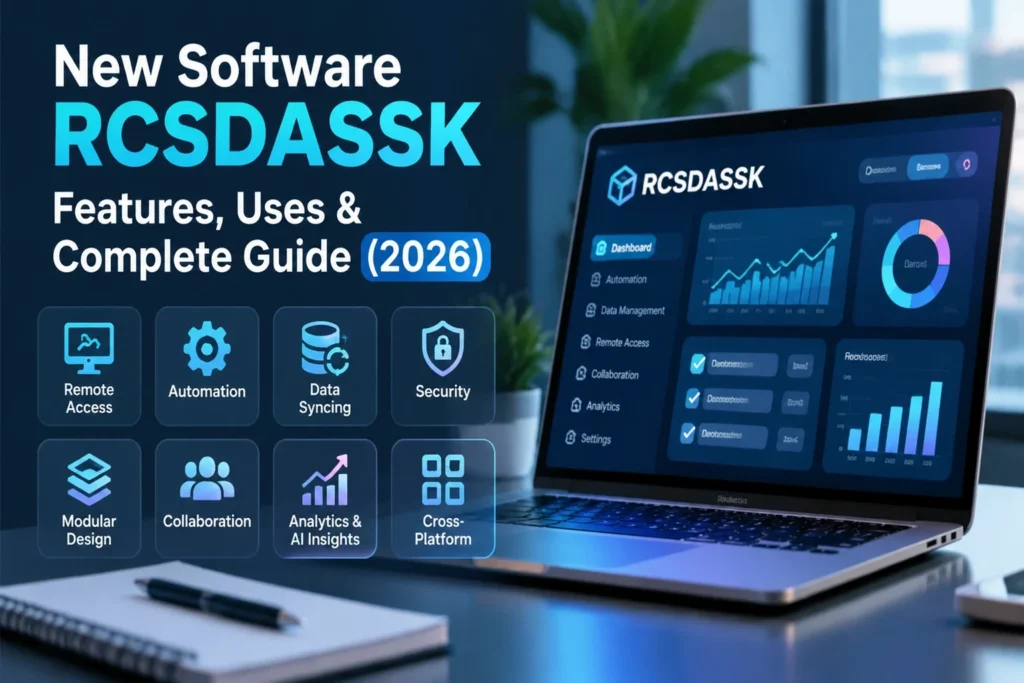
Several competitor articles describe RCSDASSK as a platform that could combine different business and technology functions. Their proposed capabilities include remote system access, data synchronization, workflow automation, analytics, and team collaboration. However, these features remain unverified rather than confirmed product specifications.
Understanding these features as proposed capabilities helps readers identify what to look for when evaluating an unfamiliar software solution.
Remote System Access
Remote system access allows authorized users to connect to computers or servers from another location. Businesses commonly use this type of functionality to maintain systems, provide technical support, and manage distributed infrastructure.
A legitimate remote access application should provide clear permission controls, authentication options, connection records, and the ability to revoke access when necessary.
Automated Data Syncing
Data synchronization keeps information consistent across connected devices, applications, or storage environments. It can reduce manual file transfers and help teams work with updated information.
When evaluating a platform that advertises automated syncing, check whether it supports scheduled synchronization, conflict resolution, data recovery, and access restrictions.
Advanced Security Protocols
Security is an important consideration for any application that handles business information or provides remote access.
Useful security capabilities include:
- Multi-factor authentication (MFA).
- Role-based access control.
- Encryption during data transmission.
- Security activity logs.
- Regular vulnerability updates.
- Backup and recovery options.
These are evaluation criteria, not verified RCSDASSK features.
Modular Architecture
Modular architecture allows software components to operate as separate modules while working within a larger system. Organizations can select the components they need instead of deploying unnecessary functionality.
For example, a business might require project management and reporting tools without needing remote device administration.
Customizable Dashboard
A customizable dashboard brings important information into one interface. Depending on the application, it may display project progress, task assignments, system alerts, or performance measurements.
An effective dashboard should make essential information easy to find without overwhelming users with unnecessary charts and notifications.
Cross-Platform Compatibility
Cross-platform compatibility allows applications to operate across different operating systems and devices.
Before choosing any business platform, verify its supported operating systems, browser requirements, mobile availability, and minimum hardware specifications. Do not assume RCSDASSK supports Windows, Linux, macOS, or mobile devices without official documentation.
Collaboration Tools
Collaboration software helps employees communicate, share documents, assign responsibilities, and monitor project progress.
Useful functions may include team messaging, shared workspaces, file permissions, task boards, and activity notifications.
AI-Driven Insights
Artificial intelligence is increasingly used to analyze business information, identify patterns, generate reports, and support decision-making.
However, an AI feature should be evaluated based on its actual capabilities, data handling practices, accuracy, and transparency. No verified evidence currently establishes that RCSDASSK contains an AI-powered analytics engine.
3. Benefits of Using RCSDASSK
The benefits associated with a unified software platform depend on the tools it actually provides. The proposed RCSDASSK concept focuses on bringing different digital operations together, but its advertised benefits should not be treated as proven results.
Here are some potential advantages of this type of software solution.
Increased Efficiency
Automating repetitive activities can reduce manual work and give employees more time for important responsibilities.
For example, a business might automate recurring reports, task notifications, or routine data transfers using a properly configured automation platform.
Enhanced Security
Centralized access management can help businesses maintain better control over their digital resources.
However, security depends on implementation, authentication, encryption, software maintenance, and employee practices. Installing a new application does not automatically make a computer or business network more secure.
Improved Remote Collaboration
Remote collaboration tools allow employees to coordinate work without sharing the same physical office.
Shared documents, task assignments, and communication channels can make it easier to manage projects across different locations.
Scalable for Growth
A scalable software solution should accommodate additional employees, increased data volumes, and changing business requirements.
Businesses should examine user limits, storage capacity, integration options, and pricing before choosing a platform.
Cost Savings
Combining several functions into one application may reduce overlapping subscriptions and administrative work.
Nevertheless, the total cost should include implementation, training, support, maintenance, and potential integration expenses.
User-Friendly Interface
An easy-to-use interface reduces the learning curve and makes software adoption easier for employees.
Clear navigation, helpful documentation, accessible settings, and straightforward onboarding are important qualities to evaluate.
4. System Requirements
System requirements determine whether an application can operate correctly on a particular computer or device.
Some online RCSDASSK articles publish specific processor, RAM, storage, and operating system requirements. However, those specifications have not been supported by an independently verified developer or official technical documentation.
For this reason, the following table provides a general checklist for evaluating business software rather than claiming to list RCSDASSK’s minimum requirements.
| Requirement | What to check |
| Operating system | Supported Windows, macOS, or Linux version |
| Processor | Developer’s recommended CPU |
| RAM | Memory needed for normal operation |
| Storage | Installation and working storage |
| Internet | Connection requirements for cloud functions |
| Browser | Supported browser versions |
| Permissions | Required user or administrator access |
| Security | Authentication and device protection |
Before installation, compare the published requirements with your computer’s specifications. This can help prevent compatibility problems and unnecessary troubleshooting.
5. How to Install RCSDASSK
Before looking for a new software RCSDASSK installer, establish whether a legitimate application and an authorized distribution source exist.
At present, the supplied competitor pages do not establish an authenticated RCSDASSK download. Therefore, providing a made-up download link or installation command would be misleading.
Microsoft recommends obtaining programs from trusted publishers and retail sources. Its Windows security guidance also explains how downloaded files may receive additional protection and warnings.
For Windows/macOS:
If an independently verified RCSDASSK publisher becomes available, use this general software installation checklist:
- Identify the software developer through an independently verifiable source.
- Locate the publisher’s official distribution page.
- Confirm that the installer matches your operating system.
- Review the file name, publisher information, and digital signature where available.
- Scan the downloaded file using trusted security software.
- Review the installation permissions before proceeding.
- Install the application only after confirming its authenticity.
Never disable antivirus protection simply because an unfamiliar installer requests it.
6. Getting Started: A Step-by-Step Guide
Getting started with a new application requires more than completing an installation. Users should understand its functions, review its permissions, and configure the available settings according to their needs.
Because RCSDASSK’s actual interface and onboarding process have not been verified, the following steps are general recommendations for evaluating a new business application.
Step 1: Create an Account
If a verified application offers account registration, review its privacy policy and account requirements first.
Use a unique password and enable multi-factor authentication when supported.
Step 2: Customize Your Dashboard
Explore the available settings and organize important information into useful categories.
Avoid enabling unnecessary notifications or displaying sensitive information to unauthorized users.
Step 3: Add Devices
If the application supports device management, review its pairing and authorization process.
Only connect devices that you own or are authorized to manage. Remove access from devices that are no longer in use.
Step 4: Set Up Automation
Start with simple, low-risk activities before creating complex automated workflows.
Test each automation to confirm that it performs the intended action without changing or deleting important information.
Step 5: Invite Team Members
For business applications, assign permissions according to each employee’s responsibilities.
Avoid giving every user administrator access. Review account activity and remove unnecessary permissions regularly.
7. Real-World Applications
Software platforms that combine collaboration, automation, analytics, and system management can support different business activities.
Although these applications represent possible use cases for the RCSDASSK concept, they should not be interpreted as confirmed integrations or existing customer deployments.
IT Departments
IT teams may use integrated management tools to organize technical tasks, monitor infrastructure, document incidents, and coordinate system maintenance.
Remote administration capabilities can also help technical staff support employees working from different locations.
Digital Marketing Agencies
Marketing agencies manage multiple projects, clients, content calendars, reporting activities, and communication channels.
Suitable workflow software can help organize these responsibilities, reduce repetitive administration, and maintain clearer project records.
Education Sector
Schools, colleges, and training organizations use digital platforms to coordinate assignments, share educational resources, and manage communication between teachers and students.
Access permissions are especially important when applications handle student information.
Healthcare
Healthcare organizations require reliable systems for administrative coordination, scheduling, documentation, and secure information management.
Any software used for protected health information must undergo appropriate privacy, security, and regulatory review. Do not assume an application is HIPAA-compliant without evidence.
Startups and Freelancers
Small businesses and independent professionals often need affordable ways to organize projects, communicate with clients, and track deadlines.
A suitable software solution should provide useful functionality without introducing unnecessary complexity or ongoing costs.
8. Security and Compliance
Security should be one of the first considerations when evaluating unfamiliar software, particularly when an application requests access to business files, computer systems, or remote devices.
Although some competitor articles claim that RCSDASSK supports AES-256 encryption, multi-factor authentication, GDPR, HIPAA, and ISO 27001 compliance, no independently verified product documentation establishes these claims.
Before trusting any software platform, examine the following areas.
Data Encryption
Check whether the application encrypts information during transmission and storage. Ask which encryption methods are used and how encryption keys are managed.
Multi-Factor Authentication
MFA adds another verification step when users sign in. It can reduce the risk of unauthorized account access when passwords are compromised.
Access Control
Role-based permissions help ensure that employees can access only the information and functions required for their responsibilities.
Data Backup and Recovery
A reliable backup process protects important information against accidental deletion, hardware failures, and certain security incidents.
Check how frequently backups are created, how long they are retained, and whether restoration procedures have been tested.
Regulatory Compliance
Businesses handling personal, financial, or healthcare information should review the applicable legal requirements.
Look for independently verifiable compliance documentation rather than relying on general statements in promotional articles.
9. Pricing and Licensing
Software pricing can influence whether a platform is suitable for individuals, small businesses, or large organizations.
Some competitor articles list RCSDASSK pricing plans of $29.99 for Pro and $79.99 for Business, along with free and enterprise options. However, these prices have not been verified through an official pricing page or confirmed software publisher.
Consequently, these figures should not be treated as actual RCSDASSK subscription prices.
When evaluating any business software, consider the following pricing factors:
| Pricing factor | What to investigate |
| Free plan | Available features and usage restrictions |
| Monthly subscription | Recurring payment requirements |
| Annual subscription | Discounts and renewal conditions |
| User licenses | Cost per employee or account |
| Storage | Additional data storage charges |
| Integrations | Fees for external connections |
| Support | Availability of technical assistance |
| Cancellation | Refund and subscription termination policies |
Before purchasing an application, request transparent pricing information and review the licensing agreement.
10. Common Issues and Troubleshooting
Software problems can interrupt everyday activities, delay projects, and affect system performance. However, troubleshooting should begin with identifying the actual application and error message rather than assuming that every technical problem is related to RCSDASSK.
One supplied competitor describes a specific RCSDASSK error code involving corrupted files, permissions, dependencies, and network problems. However, no independent technical documentation establishes RCSDASSK as a recognized operating system error identifier.
Problem: Installation Fails
An installation may fail because of insufficient permissions, an incompatible operating system, incomplete downloads, or damaged installation files.
What to do:
- Check the application’s documented system requirements.
- Confirm that the installer came from an authentic publisher.
- Check available storage space.
- Review the exact installation error message.
- Download another copy only from a verified distribution source.
Avoid running an unknown installer with administrator privileges simply to bypass an installation warning.
Problem: Cannot Connect to a Remote Device
Remote connection problems can result from network interruptions, incorrect credentials, blocked connections, or device availability.
What to do:
- Confirm that both devices are connected to the network.
- Check the account credentials.
- Review the application’s documented network requirements.
- Confirm that remote access is enabled on the authorized device.
- Review firewall alerts before changing network permissions.
Problem: Automation Scripts Not Running
Automated tasks may fail because of incorrect triggers, missing permissions, invalid input data, or unavailable services.
What to do:
- Check the automation schedule.
- Review the execution history.
- Confirm that the account has the required permissions.
- Test the workflow with non-critical information.
- Check whether a connected service is unavailable.
Problem: Software Runs Slowly
Slow performance may be caused by limited system resources, excessive background activity, outdated applications, or network problems.
What to do:
- Close unnecessary background applications.
- Check available memory and storage.
- Review CPU and memory usage.
- Install verified application updates.
- Restart the computer if temporary system problems persist.
Problem: Unexpected Security Warning
An unfamiliar application may trigger a Windows security warning because its publisher or download reputation cannot be verified.
Do not immediately ignore the warning.
Microsoft explains that Windows Attachment Manager can identify downloaded files and display security warnings. Microsoft Defender SmartScreen also helps identify potentially unsafe downloads and websites.
Review the publisher, file origin, and security information before deciding whether an application is safe.
11. Tips for Maximizing Efficiency
Good software management practices can improve productivity, reduce technical problems, and make digital workflows easier to maintain.
The following recommendations apply to business applications generally, including any future verified RCSDASSK release.
- Use Templates: Reusable templates can reduce repetitive setup work and help maintain consistent processes.
- Enable Notifications: Configure important alerts without creating unnecessary interruptions.
- Regular Backups: Maintain backups of important business information and periodically test recovery procedures.
- Audit Access Logs: Review account activity and remove unnecessary user permissions.
- Update Frequently: Install verified security patches and stable application updates.
- Monitor Performance: Track resource usage and identify applications that consume excessive system resources.
- Document Workflows: Keep clear records of important configurations, integrations, and automated processes.
- Train Employees: Make sure users understand the software’s capabilities and security requirements.
A consistent maintenance routine is often more useful than installing multiple tools without a clear operational purpose.
12. Future Outlook
The future of business software is increasingly shaped by artificial intelligence, cloud computing, workflow automation, cybersecurity, and connected digital services.
These technologies are changing how organizations manage information and coordinate daily activities.
However, there is an important distinction between general technology developments and the future plans of a particular software product.
No verified RCSDASSK developer roadmap, public release notes, or confirmed product announcements have been established. Therefore, the following developments should be understood as broader industry trends rather than promised RCSDASSK upgrades.
Voice Commands and AI Assistants
AI assistants are becoming more useful for summarizing information, answering questions, generating content, and supporting routine business activities.
Deeper IoT Integration
Internet of Things (IoT) technology connects devices, sensors, and systems to exchange information.
Organizations can use these connections for equipment monitoring, inventory management, and operational visibility.
Blockchain-Based Audit Trails
Blockchain technology can support records that are difficult to alter without detection.
Its practical value depends on the application, implementation costs, governance, and the specific business problem being addressed.
Native Mobile Applications
Mobile applications give employees access to work-related information while away from their primary computers.
Businesses should evaluate mobile security, offline functionality, synchronization, and device compatibility.
Cloud-Based Virtual Desktops
Cloud-based desktop environments allow users to access managed computing resources remotely.
They can support distributed teams, centralized administration, and flexible access to business applications.
These developments illustrate where software technology is heading. They do not confirm that RCSDASSK currently offers or plans to introduce these capabilities.
13. Final Thoughts
The interest surrounding new software RCSDASSK raises an important question: what information is actually available about the application?
Several websites describe RCSDASSK as a modern business platform involving automation, remote access, analytics, and collaboration. However, their descriptions do not establish a consistent product definition, verified developer, authentic download, confirmed pricing, or documented release history.
For individuals and businesses, the safest approach is to verify the publisher and technical documentation before downloading or purchasing unfamiliar software. Modern software can improve productivity, simplify business processes, and support better collaboration. Nevertheless, these benefits depend on selecting reliable tools with transparent functionality, appropriate security controls, and genuine technical support.
Until more authoritative information becomes available, treat RCSDASSK as an unverified software-related term rather than an established commercial application.
Frequently Asked Questions
What is RCSDASSK?
RCSDASSK is a software-related term discussed across several technology websites. Some describe it as a business automation and collaboration platform, but a verified commercial product, official developer, and confirmed feature list have not been established.
Is new software RCSDASSK available to download?
There is currently no authenticated RCSDASSK installer established by the supplied sources. Users should avoid third-party download links until an official publisher and legitimate distribution channel can be verified.
What does RCSDASSK stand for?
There is no established official expansion of RCSDASSK. Different websites provide conflicting definitions, so none should be presented as its confirmed technical meaning.
What is the RCSDASSK program used for?
Online descriptions associate the RCSDASSK program with data management, remote access, workflow automation, and team collaboration. However, these uses have not been verified as actual features of a released application.
What is the latest RCSDASSK release?
No independently verified release date, version number, or official release notes have been established. Check for publisher announcements before trusting claims about a new RCSDASSK release.
Is RCSDASSK safe to install?
Its safety cannot currently be established because an authenticated installer and verified publisher have not been identified. Avoid installing files from unknown websites, and check the publisher and digital signature before running unfamiliar software.
What are the newest software technologies?
Some of the important software technology developments in 2026 include: